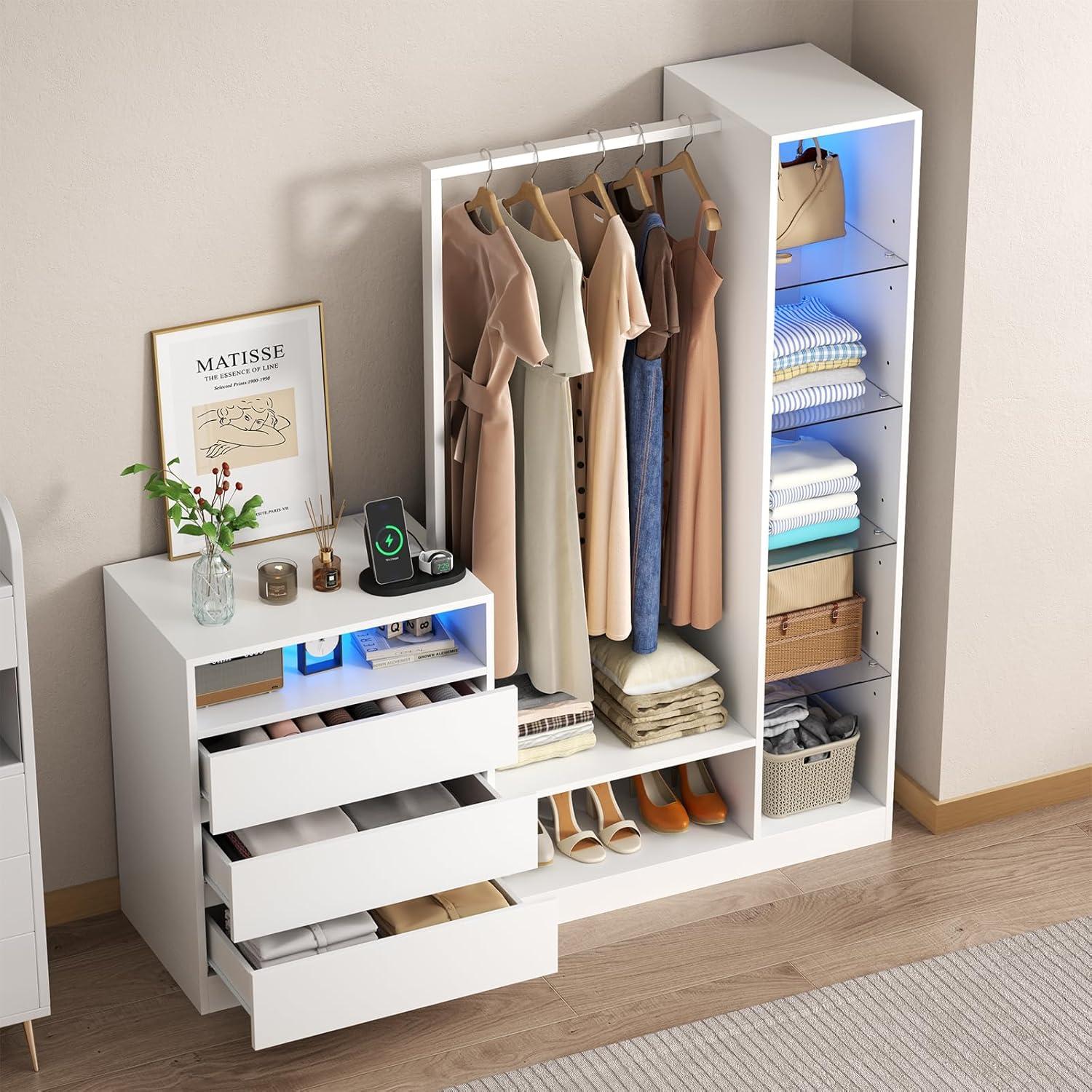
Armoire Wardrobe Closet: how it fits into your bedroom
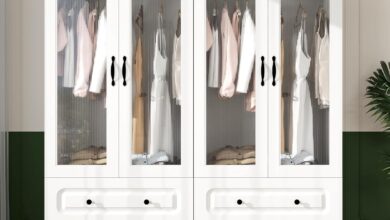
You notice the cabinet before you finish making the bed: the white “Armoire Wardrobe Closet”—a tall, narrow freestanding piece—reads more like a calm vertical anchor than a bulky dresser. when your fingers trace the engineered-wood face the finish feels smooth and slightly warm, while the tempered glass shelves and metal rail introduce a cool, precise contrast. Its slim depth and near-five-foot height change the room’s rhythm, lifting the eye up instead of across the floor. A soft press summons the LED strips and, tucked discreetly inside, a small charging module hints at fewer cord tangles—an everyday object that looks like it belongs in lived-in space rather than a showroom.
When you first open the box and bring the white armoire into your room

You lift the largest flat-packed panel out first and immediately notice how the parts are stacked: broad boards laid flat, smaller boxed components on top, and a thin envelope with the manual tucked into a corner. Each major piece is wrapped in a thin protective film and buffered by foam, and you end up peeling a few strips away with a steadying thumb while the tape sneaks at your fingers. There’s a faint, dusty-board smell that fades after a few minutes and a small cluster of labeled hardware bags that rustle when you tip the box to reach them.
Moving the pieces into the room feels more like arranging a puzzle than carrying a single unit.panels are long and flat rather than bulky, so you find yourself angling them to get through the doorway and pausing to slide one edge so it clears the trim. The heavier boards shift against each other with a soft scrape; you smooth a protective corner strip back into place and set the wrapped glass panels flat on the floor where they won’t wobble.A rapid spread of the instruction sheet on a nearby surface lets you match a couple of numbered bags to their panels before you begin assembly, and small scuffs from handling show up only on the protective film rather than the finish underneath.
How the cabinet’s proportions, doors, and painted finish sit in a bedroom
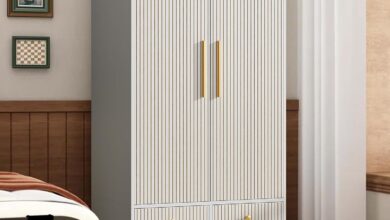
The cabinet reads as a tall, narrow piece when set against a bedroom wall: it draws the eye upward more than it stretches the room horizontally.From typical sightlines—standing by the doorway or sitting on the edge of a bed—it acts as a vertical anchor rather than a low, horizontal surface, and that sense of height is most noticeable when the rest of the furniture sits lower. In tighter floorplans the profile tends to break the line of sight across the room, while in rooms with higher ceilings it feels less imposing; small shifts in placement change that impression more than moving it a few inches left or right.
Its doors and painted surface behave like everyday surfaces in use. The doors close flush most of the time, with a modest, even gap along the edges that can widen slightly after repeated opening and closing; hinges show a small amount of lateral play rather than a rigid stop. The painted finish appears smooth at arm’s length but reveals faint texture and occasional tiny irregularities up close—fingerprints and dust register more readily on this white paint, and scuffs can become visible in areas of frequent contact. Under room lighting the finish tends to diffuse light softly rather than producing a glossy reflection, so the cabinet blends into ambient light rather of creating highlights.
| element | observed effect in a bedroom |
|---|---|
| Proportions | Reads as a vertical anchor; alters sightlines more than horizontal flow |
| Doors | Close flush with a small, sometimes variable gap; hinge play becomes noticeable with use |
| Painted finish | Matte-like diffusion of light; shows dust and fingerprints more quickly; minor surface texture visible up close |
View full specifications and available color options
Materials up close: wood surfaces, hardware details, and built in LED elements
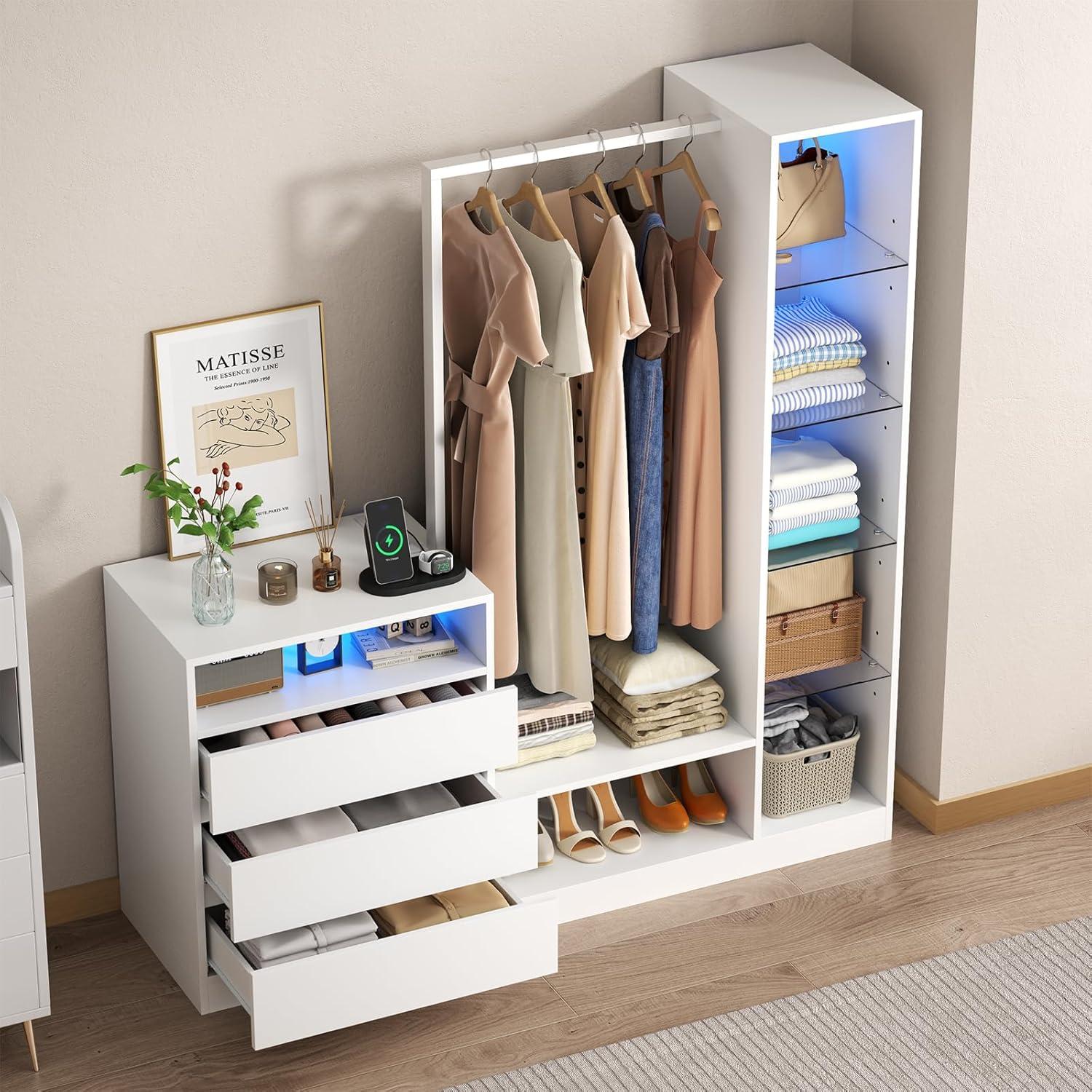
When you run your hand along the cabinet’s surfaces the first impression is of a painted, engineered-wood skin rather than raw timber. The white finish is slightly muted—more semi-matte than glossy—with a faint, uniform pattern that reads like printed grain. Panel joins are visible at close range; you find yourself smoothing a seam or tracing the rounded edge after opening a door. Small handling marks, like a thumbprint or the occasional surface scuff, show up more readily on the pale finish, and the painted edges can reveal the sandwich of core and veneer where panels meet.
Your interactions highlight the hardware in ways that a quick glance doesn’t. Drawers slide with a steady, measured resistance; you tend to pull them out fully and then give the fronts a quick tap to settle them back in.hinges swing with a short arc that keeps doors aligned, and the pull points feel intentionally modest rather than prominent. The interior rail and any visible metal fittings have that cool, metallic give when you touch them, contrasting with the warmer feel of the wood panels. Screws and fasteners register as small, practical details at the back of the unit when you move shelves or adjust components.
The built-in LED elements change how you use the interior after dark. From a few feet away the light reads as an even wash across shelves, softening shadows behind objects rather than throwing a single harsh spot. Up close the strips are recessed enough that the source itself isn’t glaring; rather you notice rim-lighting along the edges of items and a gradual fade toward the back of each compartment. The color shifts and intensity are apparent in real use—items you set inside pick up different hues as the lighting changes—and the LEDs make the cabinet feel like a subtly illuminated display when the room lights are low.
| Element | What you notice |
|---|---|
| White panels | Semi-matte finish, faint printed grain, visible panel joins |
| Drawer fronts & runners | Smooth, measured travel; fronts settle with a gentle tap |
| Hinges & pulls | Low-profile action, short hinge travel, modest pull points |
| Built-in LEDs | Recessed strips that produce an even wash and rim-lighting on shelves |
The interior you discover: drawers, adjustable shelf positions, and the hanging rod
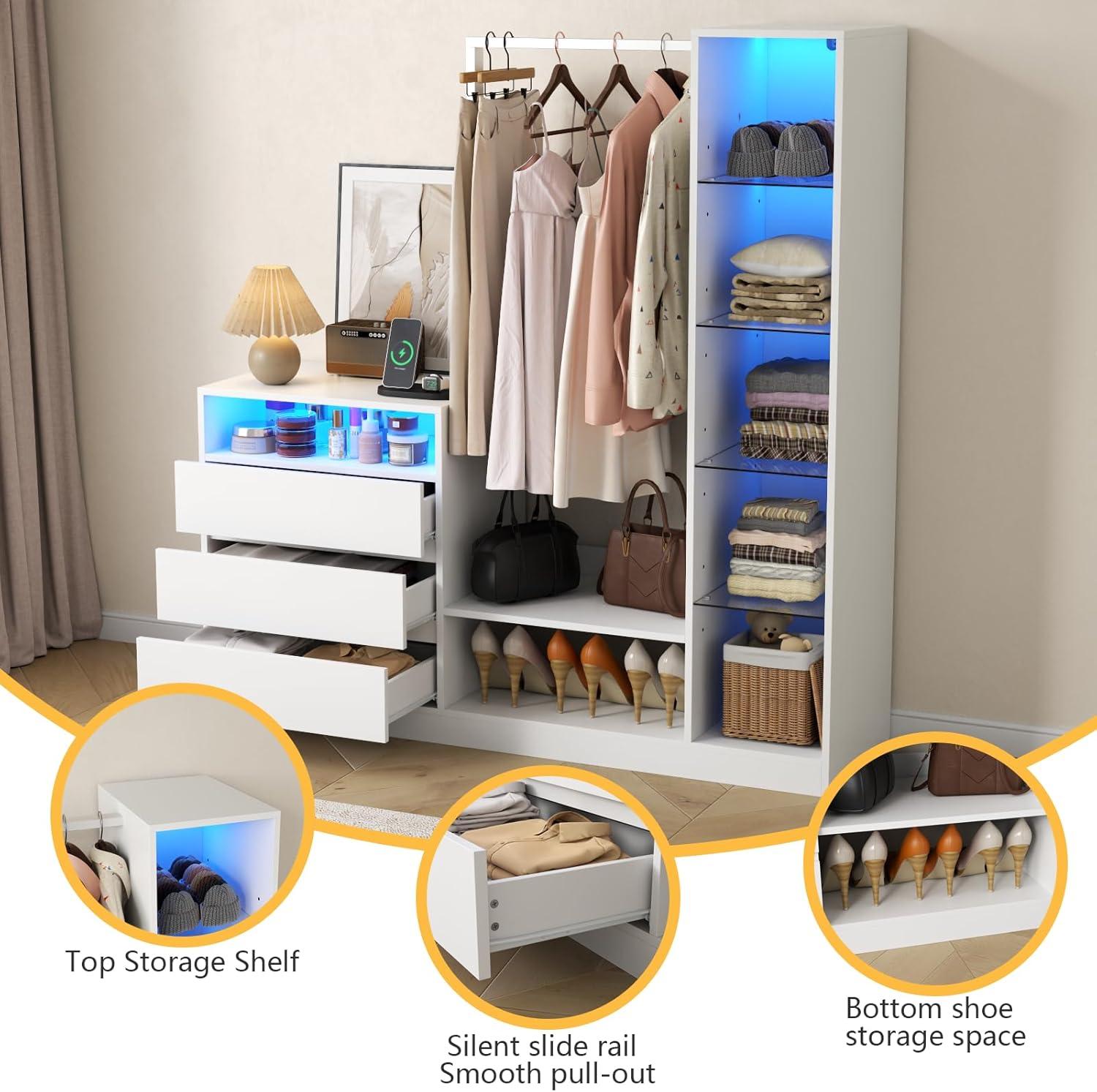
When you open the doors the interior reads as a small, working closet rather than a single shelf. A horizontal metal rod runs across the upper portion of the main bay; when you slide hangers along it they move freely and the rod settles into its brackets with a faint scrape.Long coats hang without bunching against the floor cubby most of the time, and the space below the rail becomes the natural catch for shoes or shallow storage boxes you reach for without stooping too far.
On the other side, three deep drawers sit one above another and feel like drawers meant for folded pieces. You tend to pull them open with a single hand; they glide out on simple runners and need a small push to close fully. Above the drawers is an open cubby that ends up holding the things you touch most frequently enough — a wallet, a small bag, a stack of folded tees — and you find yourself dropping items there on the way in and out.
| compartment | How it behaves in use |
|---|---|
| Hanging rod | Supports clothes across the span; hangers slide smoothly and garments usually clear the bottom cubby by a modest margin |
| Adjustable shelves | Five shelf positions that you can reposition using the peg holes; shelves sit snugly but can tilt slightly if loaded unevenly |
| Three drawers | Deep, single-handed access; runners allow a steady pull and a soft close when you nudge them shut |
| Bottom cubby | floor-level niche that collects shoes or boxes and is the spot you reach into when grabbing items in a hurry |
Because the shelves can be moved, you naturally shift them a few times as your needs change; the pegs click into place and then become part of the routine — adjusting, sliding a sweater from one shelf to another, tucking a box into a newly freed slot. Small habits emerge: you smooth the front drawer face before you close it, nudge a hanger back into alignment, or slide a pair of shoes forward so they’re visible when the doors open. Thes little motions are how the interior quickly becomes familiar.
Daily life with the built in charging station and LED lighting in your routines
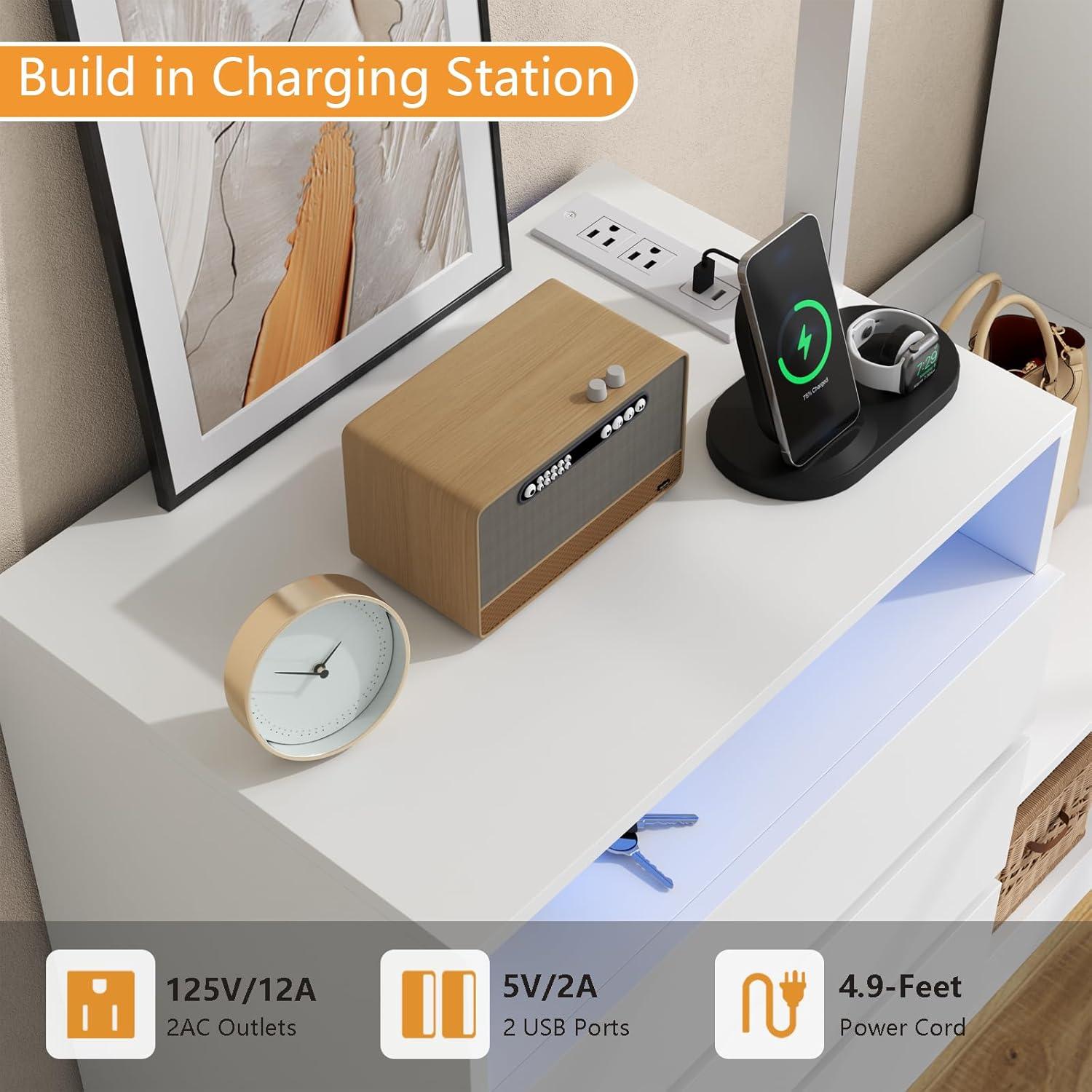
You learn quickly how the built-in outlets and USB ports settle into daily rhythms. In the morning you often plug your phone in before stepping into the shower, then drop a tablet or laptop on the top shelf to finish a podcast while you pick an outfit. The power cord reaches the nearest wall outlet without constant tugging, so the armoire becomes a predictable spot where devices live and recharge between uses. When you’re grabbing somthing from a drawer in dim light, the LED strips quietly illuminate that vertical slice of the closet, making it easier to spot socks or a missing charger without switching the overhead light on.
Later in the day the lights shift from task to atmosphere. You may tap the button or open the app to cycle through colors while sorting accessories; the music or mic-sync modes make the glow respond to whatever’s playing, which can feel like the cabinet is part of the room’s soundscape.the timing function frequently enough gets used as an implicit routine marker — lights that fade or change color as you wind down in the evening. That glow tends to be ambient rather than shining, good for mood and locating items but not as a substitute for a ceiling fixture, and cords and plugs sometimes drape when multiple gadgets are charging at once, which is a small, familiar trade-off you accept for having a single, central charging spot.
| Time | How you use charging | LED mode & effect |
|---|---|---|
| Morning | Phone and tablet top up while you get ready | Cool/neutral tones to aid visibility |
| Day / Out | Devices remain docked for grab-and-go | Off or soft color to conserve power |
| Evening | Multiple devices charge; some stay overnight | Warm hues, music-sync or timed fade for winding down |
How it lines up with your expectations, your space, and any practical constraints
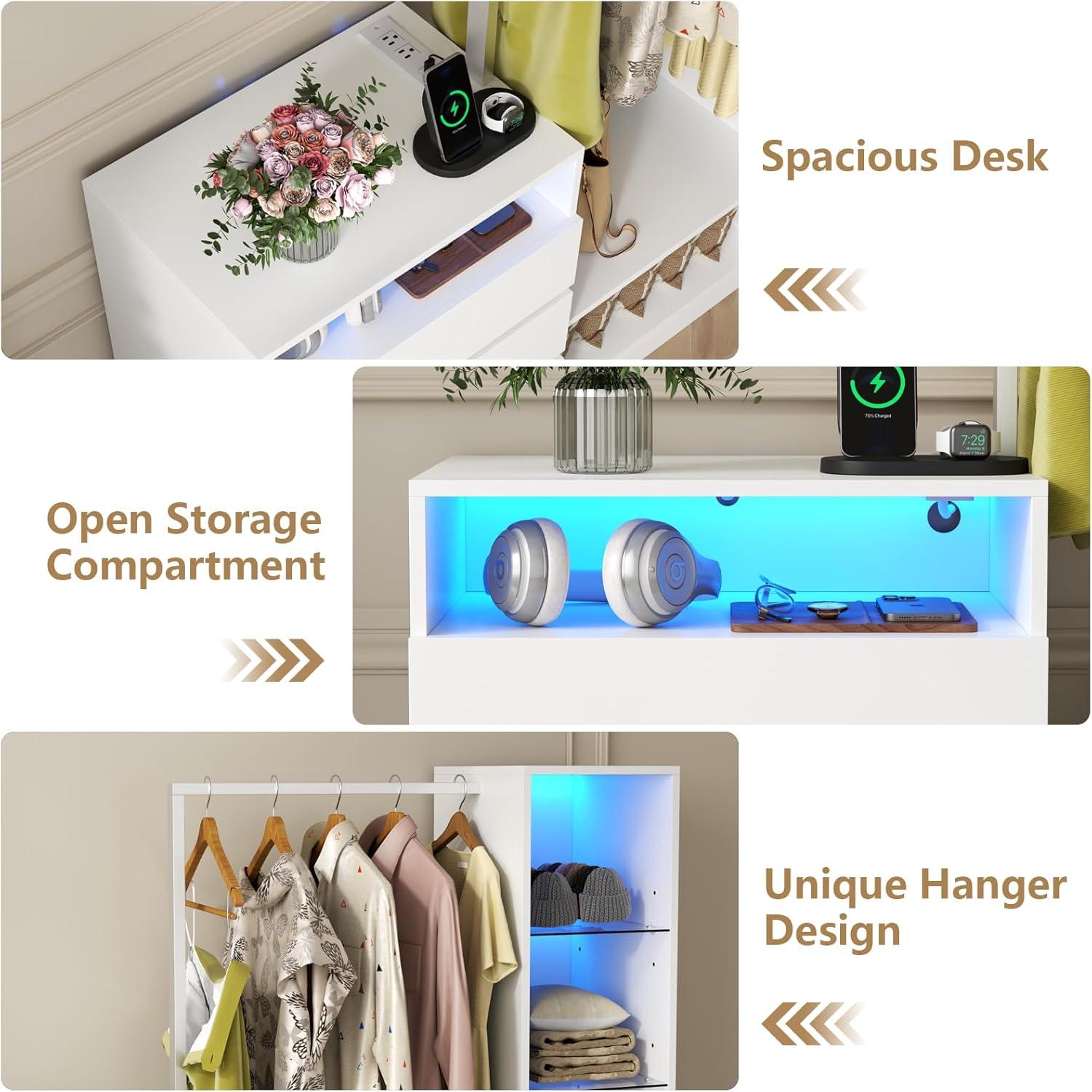
The cabinet tends to read as a compact, vertical storage solution rather than a low, spread-out piece; in a typical bedroom it occupies a noticeable visual column and often becomes a place where small daily rituals happen — devices get set down near the built-in power points, a lamp-style glow from the integrated lights gets adjusted in the evening, and drawers are opened and smoothed shut as outfits are pulled together. Placed against a flat wall it usually sits true, though it can require a little nudging to sit perfectly flush; once filled, the balance between hanging space and stacked shelves becomes apparent in daily use, with items on the glass shelves needing a touch more care when being rearranged because they can feel precarious compared with the wooden drawers.
Practical constraints show up in a few predictable ways.Placement tends to be driven by where power is available,sence the electronics are used most when close enough to an outlet,and the piece often benefits from being anchored to the wall during everyday use. Moving it through narrow doorways or past corners can feel purposeful and sometimes requires an extra pair of hands; inside, heavier items shift the center of gravity and make the anti‑tip attachment a routine part of settling it into a room.The lighting and charging features change how the cabinet is used over time — light settings are fiddled with, cords are routed and rerouted — so the lived experience is a mix of convenience and small adjustments rather than a one‑time placement.
View full specifications and size options
size and moving in: measurements, doorway clearances, and how it fits around other furniture
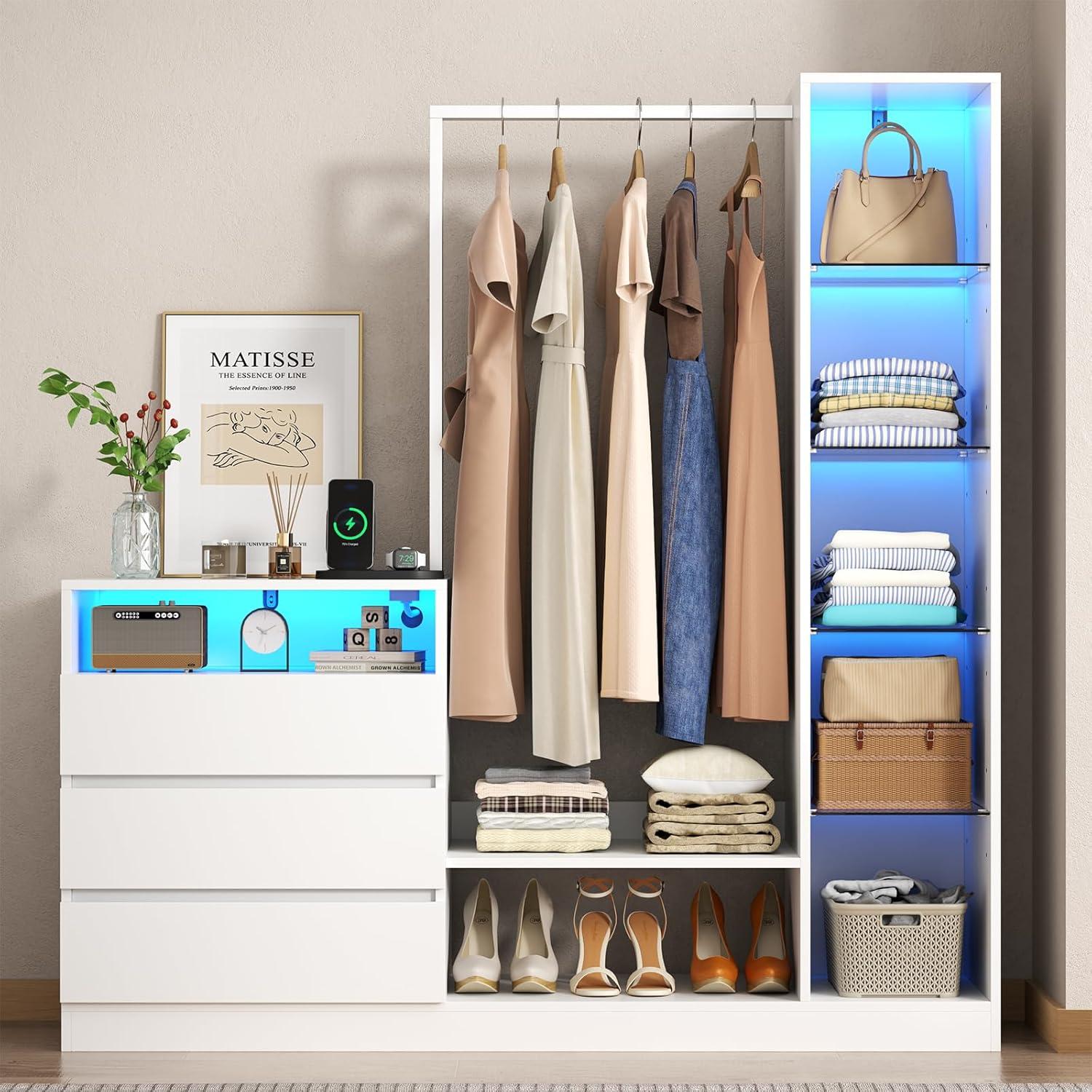
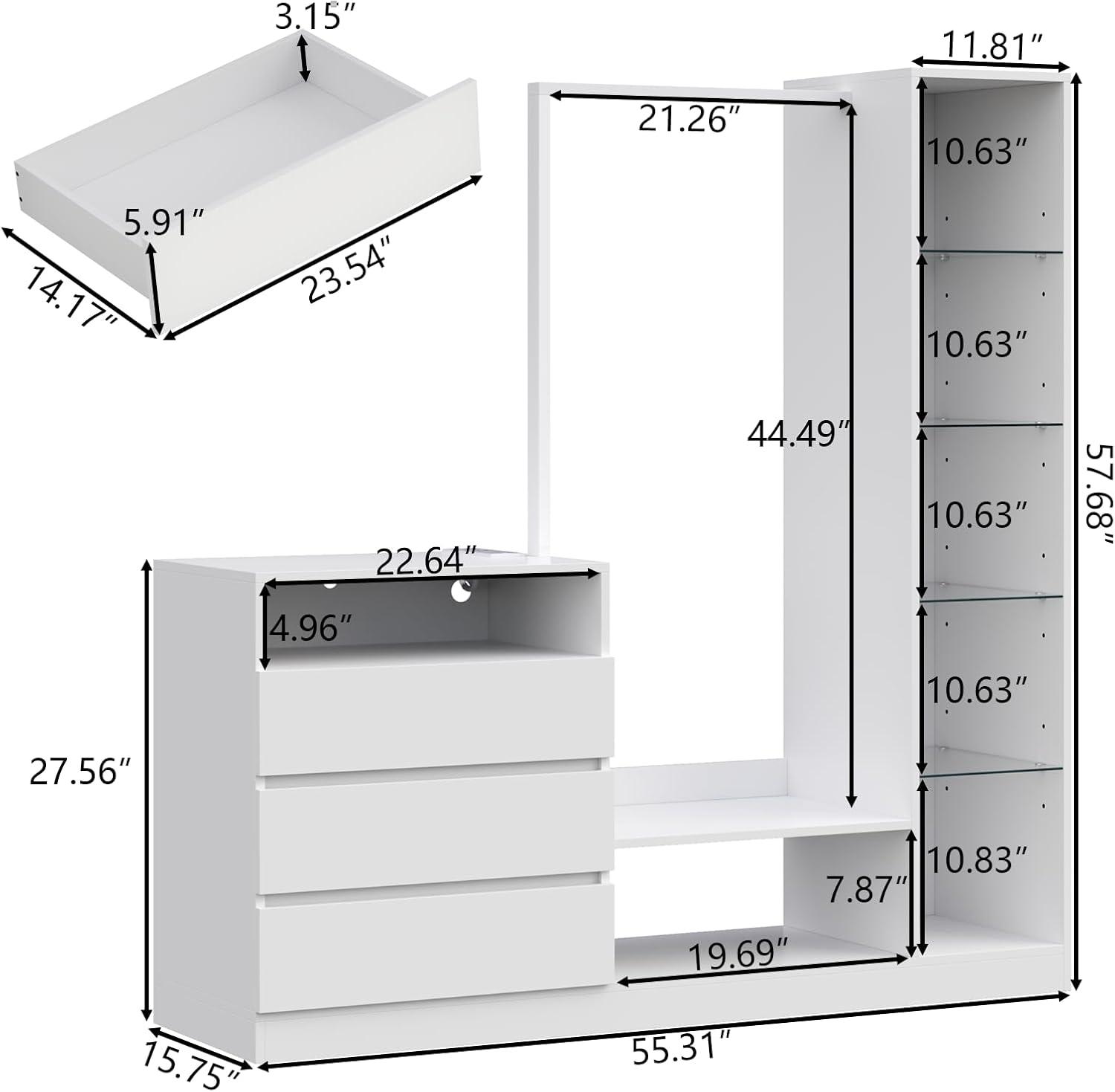
The assembled cabinet measures about 55.31 inches long, 15.75 inches deep and 57.68 inches high. In practise that length is the first thing that dictates how it gets through doorways and around corners: an assembled span of roughly 55 inches will not fit through a typical 32-inch interior door without taking it apart or passing it in on its side. Narrow hallways and tight stair turns tend to force a change of orientation as the piece moves from truck to room, and the shallow depth means the sides can brush against door frames or moulding rather than clearing them cleanly.
| Dimension (assembled) | Observed implication |
|---|---|
| 55.31 in (length/width) | Exceeds many standard door openings; may require partial disassembly or angled entry |
| 15.75 in (depth) | Sits close to adjacent furniture; limited setback from walls once positioned |
| 57.68 in (height) | Taller than low dressers but under typical ceiling heights; vertical clearance rarely an issue |
As the unit ships flat-packed and is assembled in place in most cases,installers commonly handle panels and the hanging-rod section through the doorway before final assembly. During those moments, edges tend to catch and installers unconsciously shift pieces—smoothing veneers, nudging drawers slightly ajar to lighten a section—so small scuffs or nicks can appear where corners rub against door jambs. Drawers and glass shelves are often separated from the main carcass while carrying,which changes how the load feels and how much room is needed to pivot around other furniture.
The relatively shallow profile means the cabinet usually tucks close to beds or sofas,with little leftover gap for things like a bedside table or a lamp base if those items sit immediately beside it. doors and drawers still need clearances to open: when the doors are swung or drawers pulled, adjacent pieces can feel close in most room layouts. Movers and assemblers tend to plan a little extra turning space during installation; or else panels might need temporary repositioning to negotiate tight passages.
How It Lives in the Space
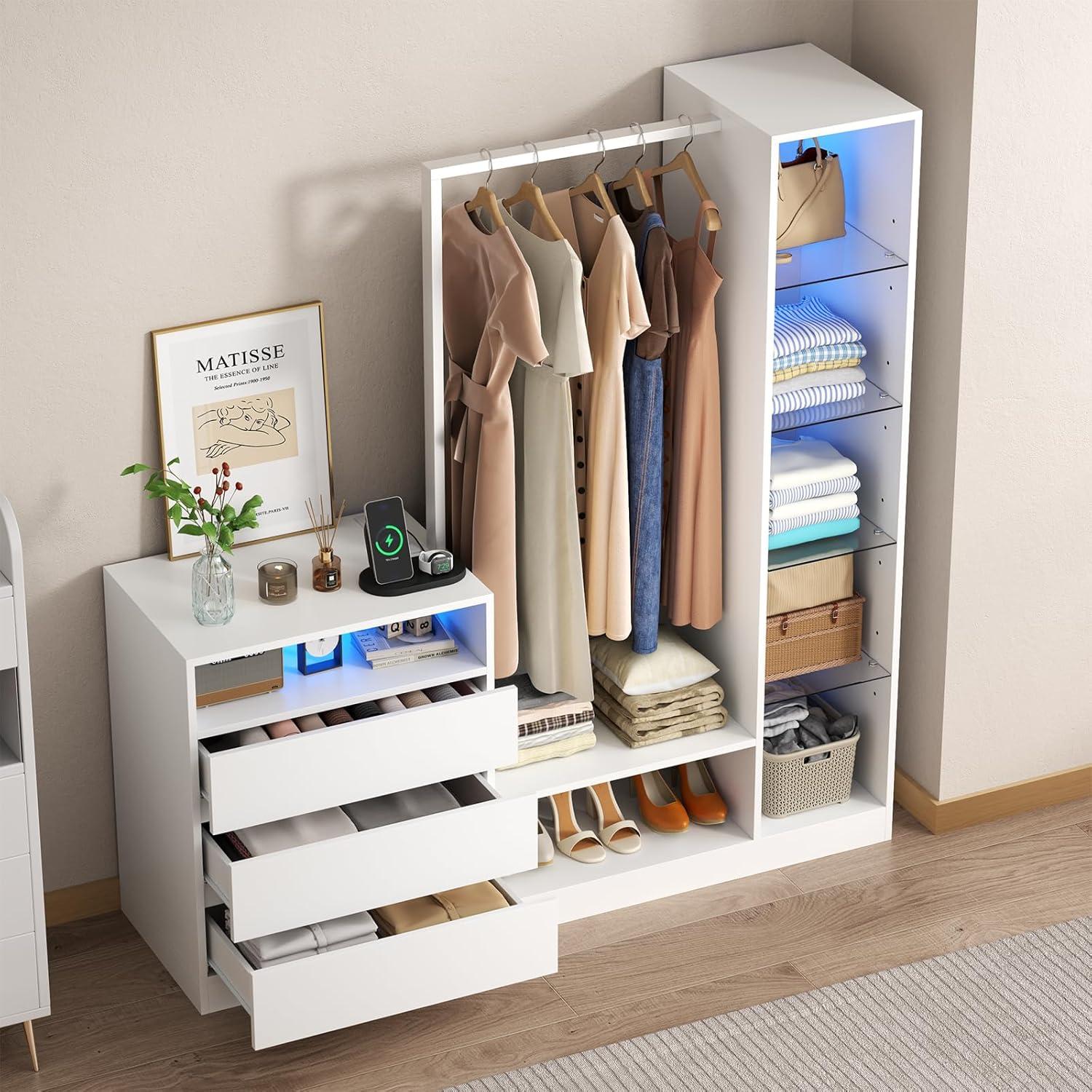
After a few weeks you notice the Armoire Wardrobe Closet with 3 Drawers & hanging Rod settling into the roomS rhythms rather than standing out as new. In daily routines you develop small habits around it, opening and closing in familiar ways and using its top and sides without thinking. Surface marks and soft scuffs show up in ordinary places, the doors and drawers easing into a quieter motion as the room is used. Over time it simply rests and becomes part of the room’s everyday rhythm.
As an Amazon Associate I earn from qualifying purchases.