LVSOMT 360° Swivel Jewelry Mirror Cabinet as you get ready
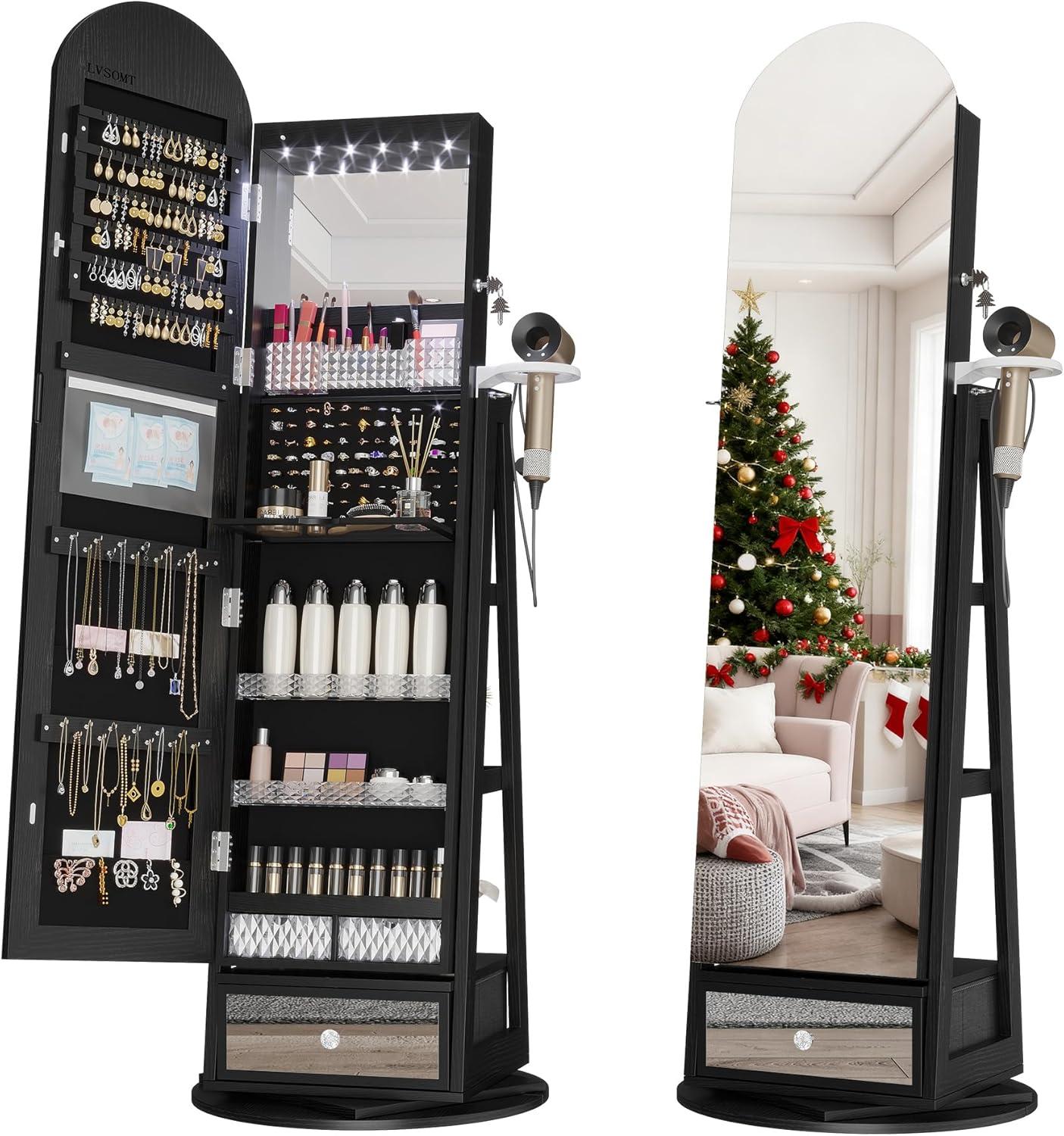
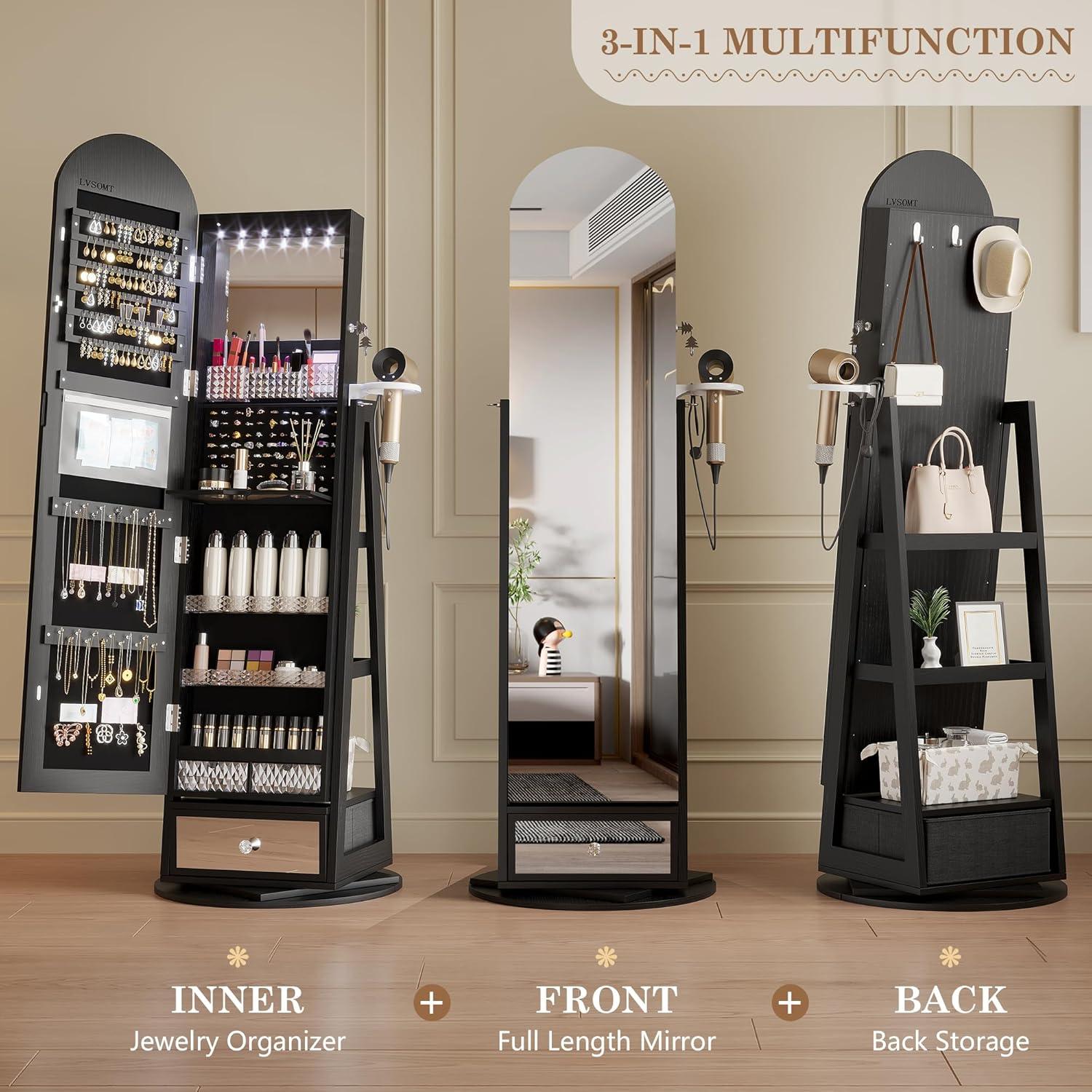
The LVSOMT 360° Swivel Arched Jewelry Mirror Cabinet — a mouthful you’ll likely shorten to “the armoire” — arrives as a tall, arch-topped mirror in a matte black frame that immediately alters the room’s vertical rhythm.Up close you notice the painted wood is smooth under your palm and the glass has a clear, unwarped depth that catches light differently as you move.Open it and a soft halo of LEDs spills out, clarifying the felt-lined shelves and shallow drawers without feeling harsh. Give the base a nudge and the cabinet pivots with a measured turn, the motion reassuringly mechanical rather than flimsy. In everyday light it settles into the space like an object meant to be used, not just admired.
Introducing the LVSOMT 360° arched jewelry mirror cabinet and what you’ll find inside
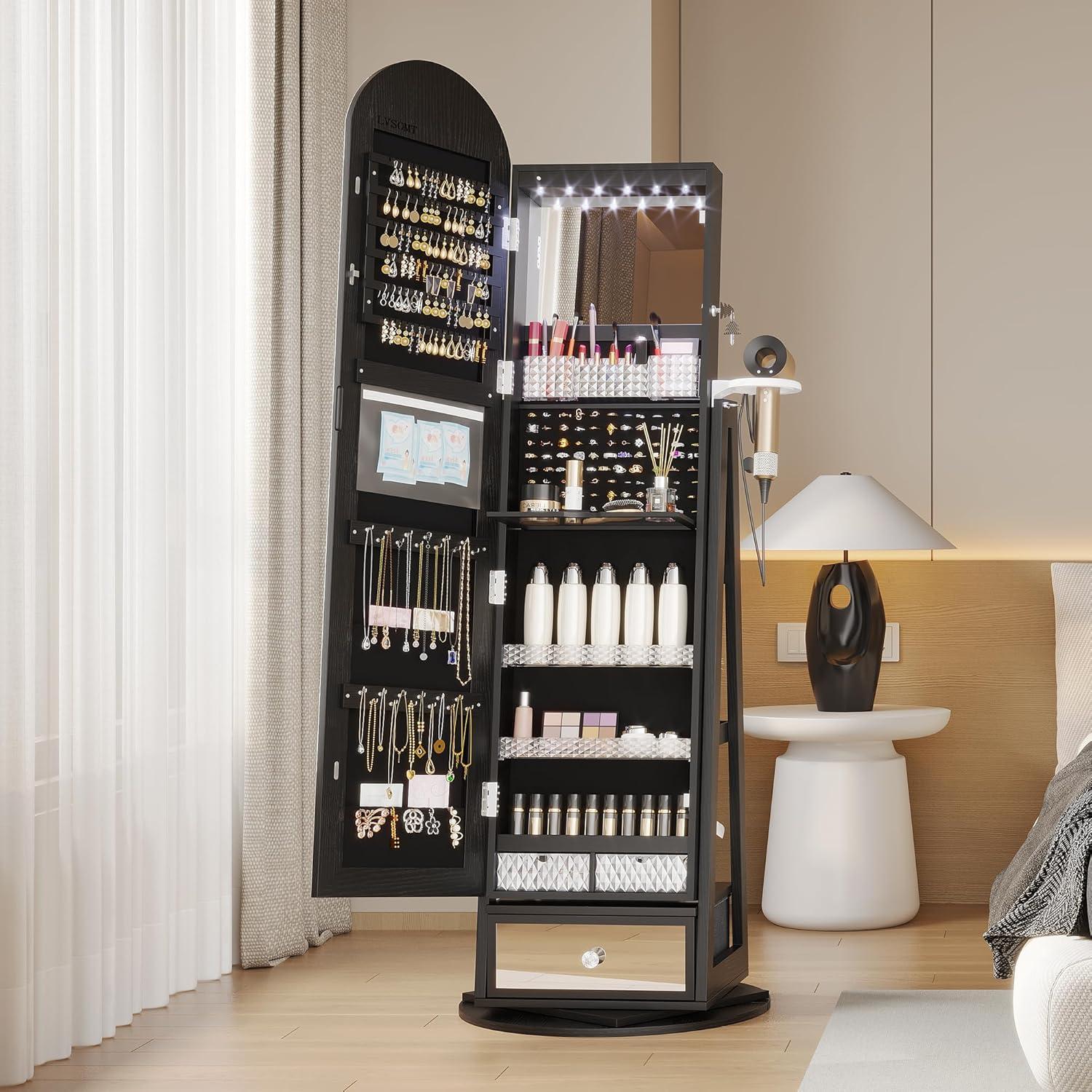
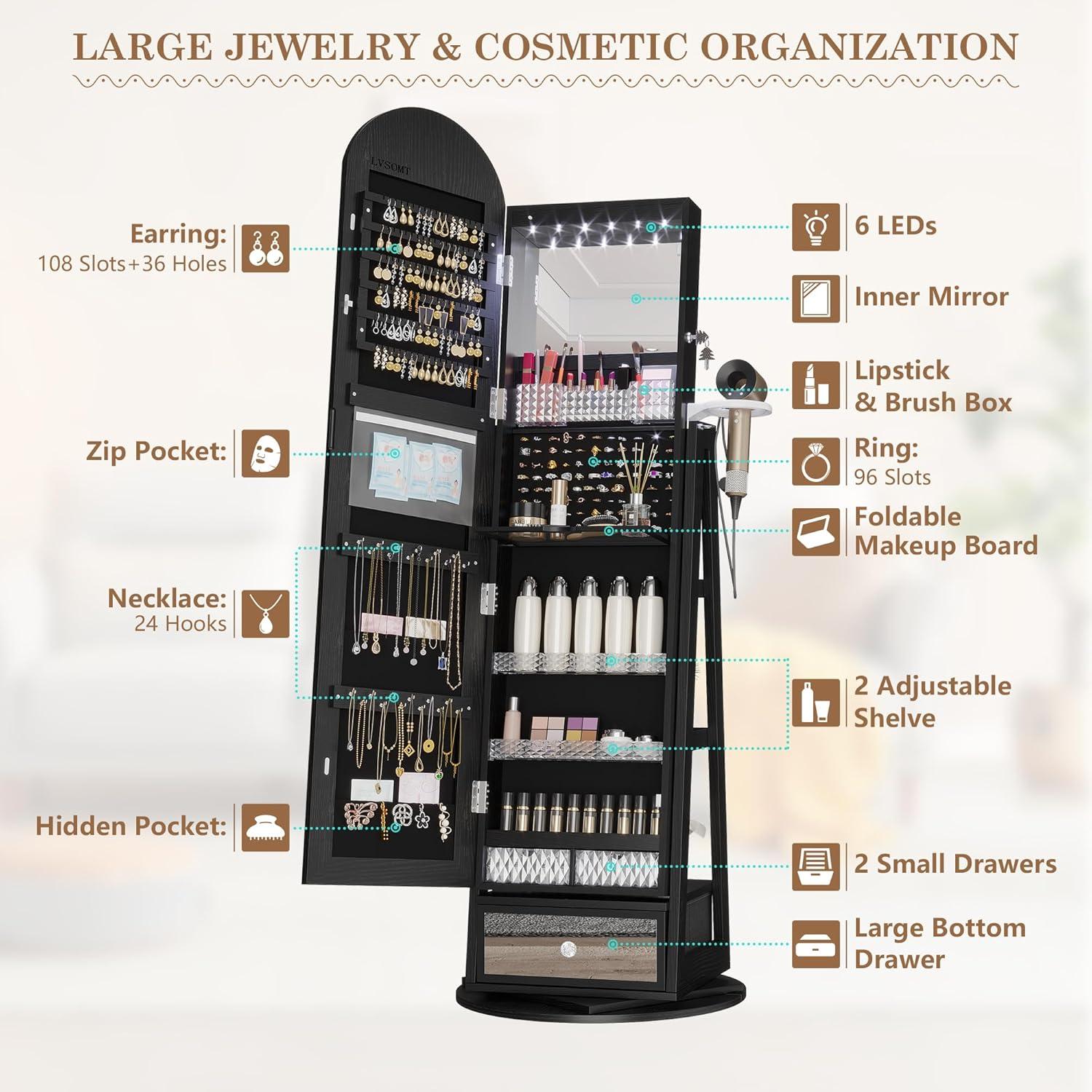
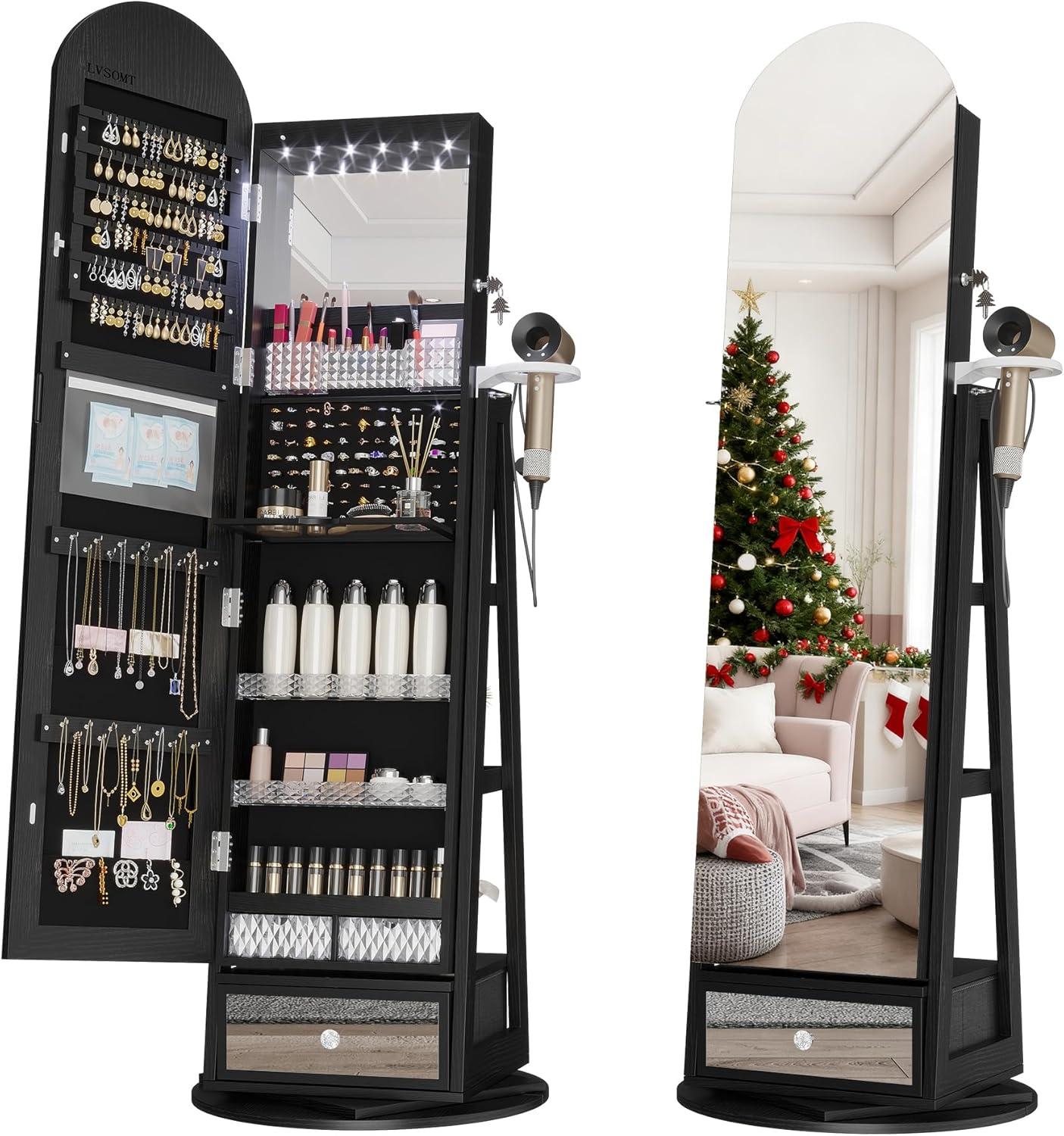
When you swing the arched door open, the interior unfolds like a compact backstage—an inner mirror catches your face while the LEDs usually come on so you can read labels and catch stray glitter. A narrow makeup shelf sits at about chest height; you’ll find yourself setting down a brush or a tube there while you fumble for a clasp. The lining inside feels soft under your fingers,and jewelry hangs,slides,or nestles into its places rather than sitting flat on a shelf.
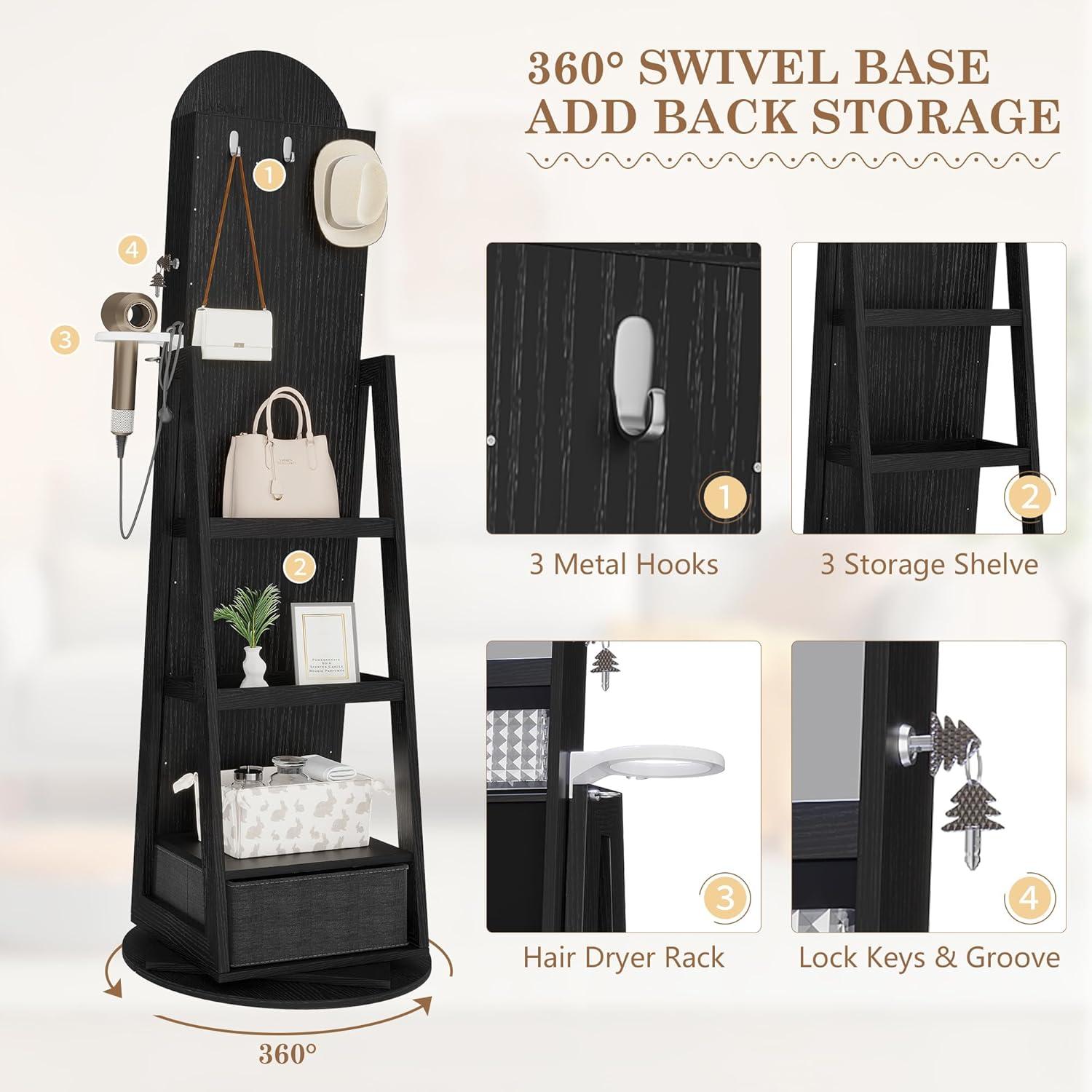
Look past the shelf and you’ll notice vertical panels for dangling pieces,small pockets and slots where rings and studs tuck in,and a couple of shallow drawers that are handy for loose things you reach for without thinking.The back of the cabinet is reachable by giving the unit a gentle turn on its base; the rotation brings a trio of shelves and extra hooks into view so you don’t have to bend or empty the front to get at what’s stored behind.As you move items around you’ll naturally smooth chains, shift stacks of bracelets, and slide drawers in and out while the cabinet’s surfaces collect a few fingerprints.
| Interior area | How you’ll use it in a routine |
|---|---|
| inner mirror & LEDs | Quick checks while applying makeup or fastening necklaces |
| Makeup shelf | Place a compact or clean off a brush mid-request |
| Panels, pockets, and slots | Hang or tuck jewelry so pieces don’t tangle |
| Drawers and lower compartment | Store bulkier or loose items you pull out occasionally |
| Rear shelves (accessible via swivel) | Hold bottles, boxes, or extras you don’t need every day |
How the cabinet looks in your room and what assembly involves
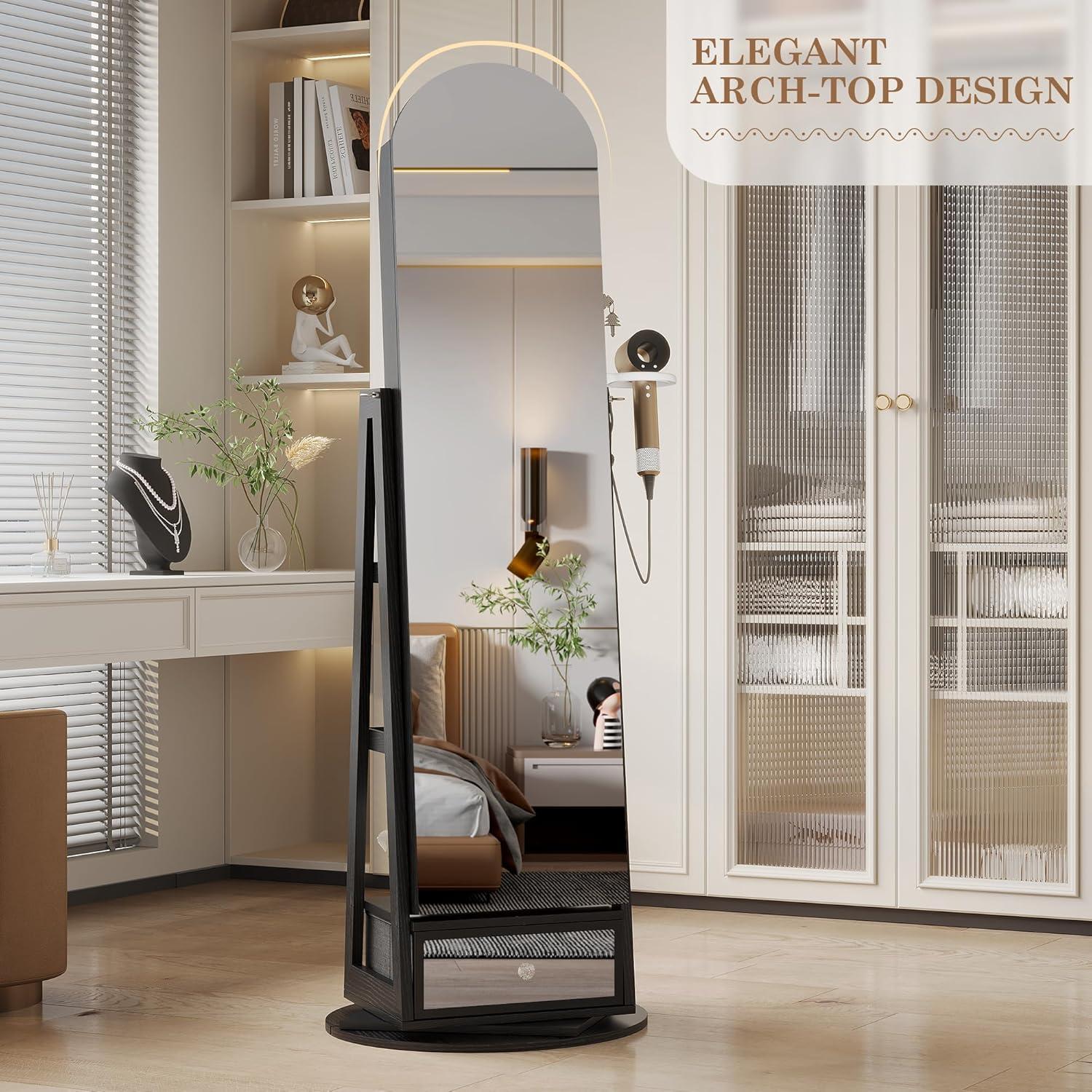
Placed against a wall or tucked into a bedroom corner, the piece reads as a tall, narrow silhouette that immediately draws the eye upward. The arched mirror creates a continuous vertical line,so you often notice more of the room reflected back than the cabinet itself; from some angles it seems slim,from others it adds a clear focal point. The black finish mutes light rather than bouncing it, which makes the mirror stand out while nearby surfaces look a touch darker. When you move around it — opening the door or turning the cabinet on its base — small sounds of wood settling and a faint squeak from hinges are part of the experience, and you’ll likely steady the unit with a hand when you first swing the door open. On a lived-in day you might find yourself brushing off a bit of packing dust, nudging a slightly misaligned edge, or smoothing the door after it’s been bumped; these are the kinds of small adjustments that happen naturally.
The assembly itself tends to be a mix of simple connections and awkward lifting. Most of the heavy panels come ready to link, but you still go through a few moments of lining up pre-drilled holes, inserting fasteners, and sliding shelves or drawers into their tracks. It’s common to set the cabinet upright only to realize a final screw or two needs tightening from the inside, so you pause to kneel, reach in, and work with the door open. A second pair of hands can make handling the taller pieces easier, though some people go it alone by bracing the unit against a wall while fastening the base. Instructions are usually pictorial, which means you sometimes pause to interpret an illustration rather than read step-by-step text.
| Typical assembly tasks | What you’ll do | Typical time |
|---|---|---|
| Attach base and swivel | Align, insert bolts, and tighten while holding the cabinet steady | 10–20 minutes |
| Install internal components | Slide shelves/drawers into place and fasten small fixtures | 15–30 minutes |
| Final adjustments | Tighten screws, align door, adjust felt pads or feet | 5–20 minutes |
A closer look at the arch, finish, LED lights, lock and hardware
when you step in front of the arched mirror, the curve at the top subtly shifts how the reflection reads — the center feels slightly emphasized and your eye is drawn upward more than with a flat-topped door. Up close the arch’s profile is smooth; from a few feet away the silhouette softens a room’s lines. As you move around it, small seams where the frame meets the door become more apparent under side lighting, and you’ll likely smooth a stray fingerprint or two on the finish after handling the door.
The exterior finish presents as a matte-to-satin black that tends to hide small scuffs but shows dust and oily marks if you run a hand along it. When you wipe the surface you’ll notice the sheen isn’t glossy, which makes reflections of nearby light sources less intrusive; at the same time the texture captures tiny surface irregularities where panels join. The hardware — hinges, screws and the rotating base — sits flush with the exterior, but the hinge points are most visible when you open the door and check alignment.
The LEDs inside come on with the door and produce a steady, cool-white band of light along the mirror. In practical use thay brighten the face evenly enough for quick checks and catching small details; they can feel noticeably brighter at certain angles and softer at others. The light circuit is automatic, so you don’t have to fumble for a switch, but you may notice the illumination change slightly as the door swings or if the mirror is turned on its base.
The lock is a small, keyed cylinder set into the side of the door. When you insert the key and turn it, the mechanism engages with an internal latch; the action is straightforward, though the key can feel a bit stiff until it’s been used a few times. Hinges and mounting plates reveal their hardware when the door is open — you’ll see where the door bears its weight and how the swivel base is anchored. In everyday use that hardware determines how easily the cabinet stays put while you open compartments or reach for items.
| Component | What you’ll notice in use |
|---|---|
| Arch | Draws the eye upward; seam lines are more visible under side light |
| Finish | Matte-satin black that masks small dents but shows dust and fingerprints |
| LED lights | Auto on/off with door; provides even, cool-white illumination that varies slightly with angle |
| lock | Keyed cylinder; engages simply but can feel stiff until broken in |
| hardware | Hinges and swivel base are visible when open; their alignment affects how steady the door and rotation feel |
What the interior contains the layout of drawers, hooks, mirror and shelf measurements
When you swing the door open, the interior reads like a staged workspace: a tall mirror panel takes up most of the door’s inner face, several padded panels and hooks line the side walls, and drawers sit low near the base. As you move through the space you notice the placement is meant to keep frequently used bits at arm’s reach — earring panels and ring cushions sit nearer the middle, necklace hooks are arranged vertically along one side, and a pull‑out makeup board tucks in at a convenient height so you can rest a compact or brush on it while using the mirror.
The measured clearances inside feel modest but usable. The interior mirror (the glass you look into from inside the cabinet) runs most of the door height, so when you stand in front of it you don’t have to lean much to see your face and torso. The three shallow rear shelves behind the cabinet open when you swivel it; each shelf has just enough depth for bottles and small boxes and the vertical spacing between those shelves is tighter toward the top.
| Interior element | Approximate measurement (observed) |
|---|---|
| Inner mirror visible area | about 48–54″ tall × 11–14″ wide |
| Pull‑out makeup shelf (board) | roughly 10–12″ wide × 7–9″ deep; positioned about mid‑chest height |
| Small upper drawers (each) | around 10–11″ wide × 8–9″ deep × 2.5–3.5″ high |
| Bottom large drawer | approximately 10–11″ wide × 8–9″ deep × 5.5–7″ high |
| Rear storage shelves (each) | about 11–12″ wide × 3.5–5″ deep; vertical spacing varies from ~4″ to ~7″ |
Other interior fittings appear in familiar places: earring panels with rows of small holes run on the inside of the door and on dedicated panels, ring slots form short padded rows, and a strip of necklace hooks sits along an inner side panel with roughly an inch or so between hooks — close enough that longer chains tend to drape rather than hang straight down. There’s also a small hidden pocket and a facial pocket tucked behind a panel; their openings are narrow and the depth matches the cabinet’s side walls, so items you slip into them sit flat against the wood.
As you handle items inside, the compartments feel arranged to reduce bending: the makeup board and most earring storage stay near eye level, while bulkier, less‑used pieces end up in the lower drawer or on the back shelves. Small shifts — sliding the makeup board out slightly, nudging a ring tray over a millimeter — will alter how much usable surface you have at any one time.
How you’ll use it day to day opening drawers, using the mirror and accessing the inner makeup shelf
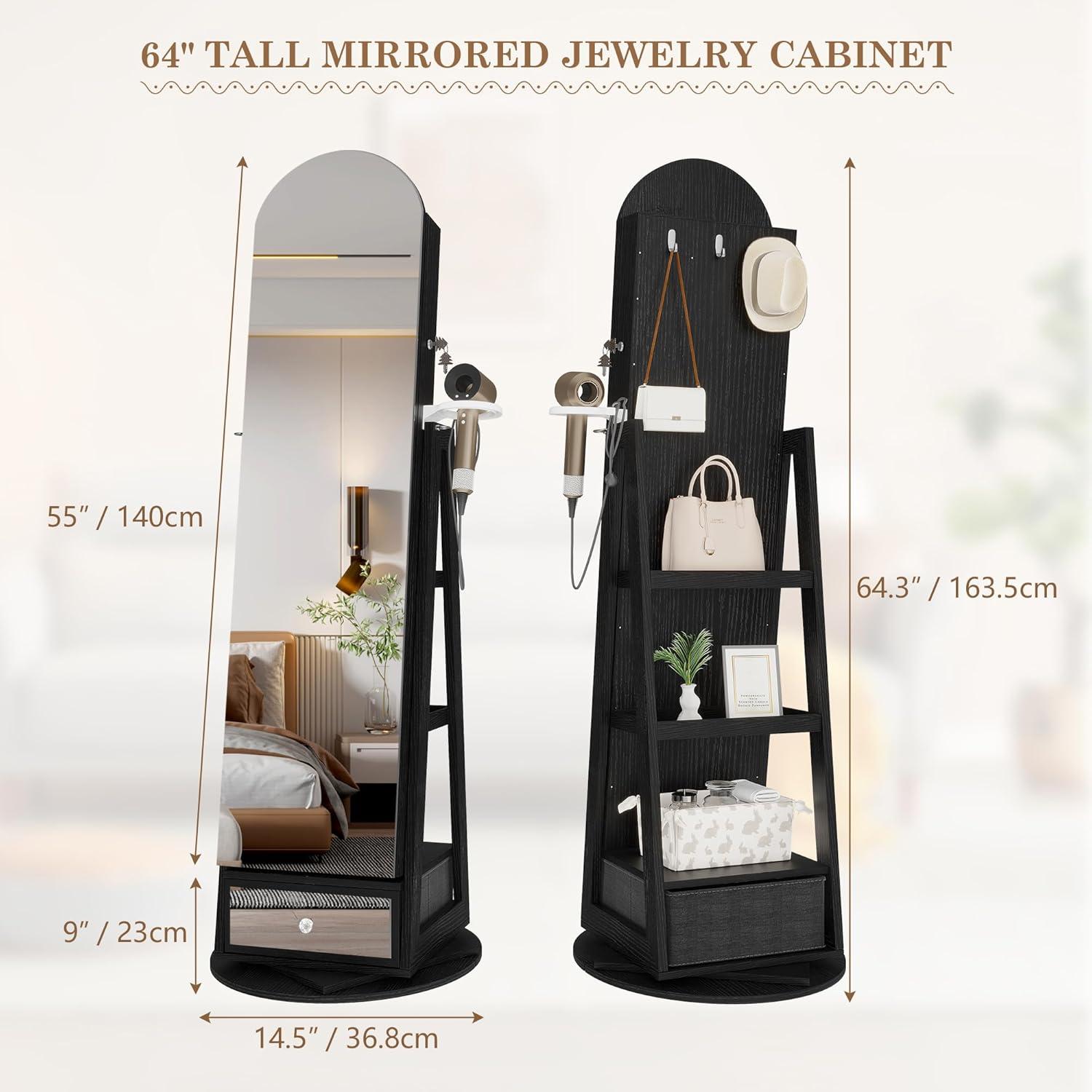
When you open the drawers, the motion becomes part of a routine: a firm pull, a short glide, then a moment of sorting as you tilt the contents toward the light. The upper drawers present shallow wells that make it easy to sweep up rings and studs with a fingertip; the lower compartment gives you room for bracelets, small palettes or a travel-sized bottle so you don’t have to juggle items onto the floor. Drawers pull far enough to see most of what’s inside, though you’ll still lean in a couple of times to reach necklaces tucked toward the back. The action tends to settle with use — a little resistance at first that eases after a few days — and you often find yourself nudging stray pieces back into place before closing them.
Using the mirror and the inner makeup shelf follows the same simple choreography. You swing the door open,the interior mirror and LEDs come into play,and the small makeup board becomes a convenient landing spot for the product you’re using that minute. Because the shelf sits roughly at chest height, you can rest a brush or set down a compact while you work without bending over, and the illuminated surface helps you see detail for close tasks. You’ll also notice the 360° swivel affects this moment: angling the cabinet a touch can reduce glare or give a different viewing angle, and from time to time you’ll steady the unit with one hand as you reach in so the door doesn’t rotate away. In everyday use these little adjustments — shifting the cabinet, leaning in to peer into the mirror, setting down and picking up items from the shelf — quickly become automatic.
How this armoire suits your space, how it matches your expectations, and where limitations emerge
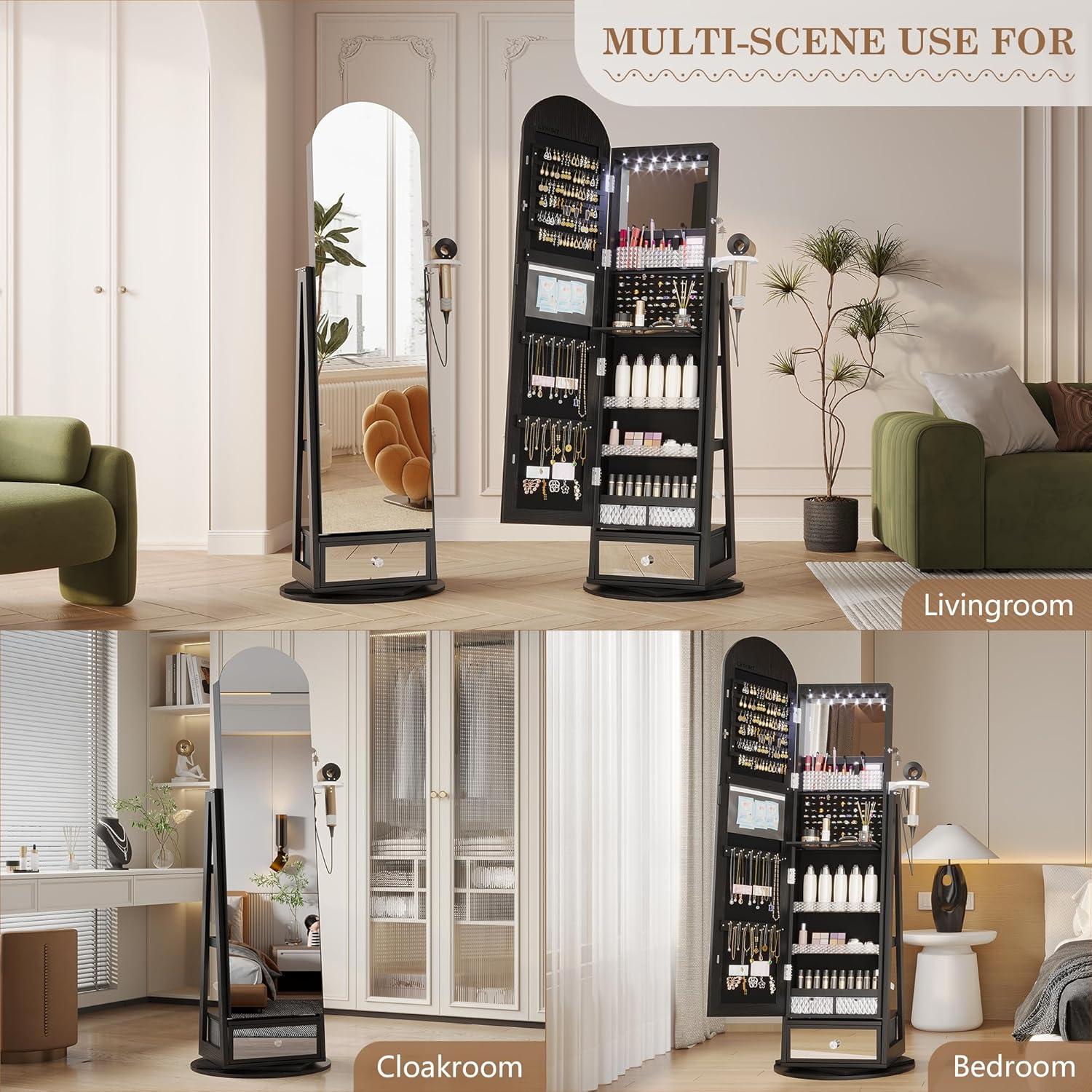
Placed against a bedroom wall or tucked into a dressing corner, the armoire reads immediately as a single, self-contained dressing station. When the door swings open and the interior lights come on, a person tends to pause and smooth a sleeve or check earrings in the reflected light; the mirror’s height makes head‑to‑toe checks possible without stepping back. Because the unit occupies vertical real estate rather than a broad footprint, it often reduces countertop clutter while still asserting a visible presence in the room.In tighter paths the rotating base can invite small adjustments — nudging a rug or angling the piece a fraction — so the daily interaction feels like part of the room’s choreography rather than a separate task.
Observed use patterns show where expectations and limits meet. Many find the storage layout lets items be corralled and reached in a single motion, and the LEDs generally illuminate the face evenly when the door is open. At the same time, the cabinet’s weight and the way the swivel mechanism behaves when the door is opened can make repositioning feel cumbersome; the rotating section may require steadying to avoid drifting. Some report the mirror sitting higher than anticipated, which changes how often one has to lean or step back for a full view. Occasional reports of shipping damage and mixed impressions of sturdiness also appear in practice,so the armoire’s day‑to‑day performance tends to balance useful consolidation against a few practical trade‑offs that show up during handling and movement.
View full specifications and available options
Everyday upkeep and handling as you live with the cabinet
Living with this cabinet becomes a series of small, habitual gestures. You open the mirrored door to check an earring or smooth a strand of hair and the interior lights usually come on without a thought; when you step back the mirror will collect fingerprints and a faint halo from makeup, so wiping it after use is part of the rhythm.Inside, drawers and pockets show their presence in everyday moves — you’ll slide a drawer for a ring, push the makeup shelf to rest a brush, and notice how small items shift a little when the door swings.
The cabinet’s mass and swivel change how you handle it. When you turn the base or swing the door open you’ll often steady the body with one hand; if you open the door quickly the armoire can rotate or rock a touch, and carrying it while loaded feels heavier than it looks.Keys live somewhere nearby once you start locking and unlocking; you’ll find yourself checking that the lock is engaged when leaving the room. Over time small signs of use appear where rings or chains rub against finishes, and hinges or fasteners may demand an occasional tighten after frequent handling.
| routine | What you’ll notice |
|---|---|
| Daily | mirror smudges,quick light activation,reaching for frequently worn pieces |
| Weekly | dusting the top and shelves,detangling necklaces,straightening earring rows |
| Occasional | repositioning the armoire if it shifts,checking lights or connections,tightening loose screws |
Small habits develop: you’ll rub off a fingerprint before leaving,nudge a stray chain back onto its hook,and keep the keys in the same spot so you don’t hunt for them. These are the everyday movements that shape the cabinet’s presence in a room more than any single specification, and most marks or minor adjustments show up gradually as part of normal use.
A Note on Everyday presence
Living with the LVSOMT 360° Swivel Arched jewelry Mirror Cabinet,64″H Standing jewelry Armoire,you notice over time how it settles into a corner of your routine rather than demanding attention. As the room is used, its scale and surface start to map onto daily rhythms — the soft rub of chains inside, the quiet give when you lean in to check a detail, faint scuffs and fingerprints that mark habitual handling. It occupies spare inches and subtly alters how you move through mornings and evenings, becoming as familiar as any domestic habit. Over time you find it simply rests there and becomes part of the room.
As an Amazon Associate I earn from qualifying purchases.